
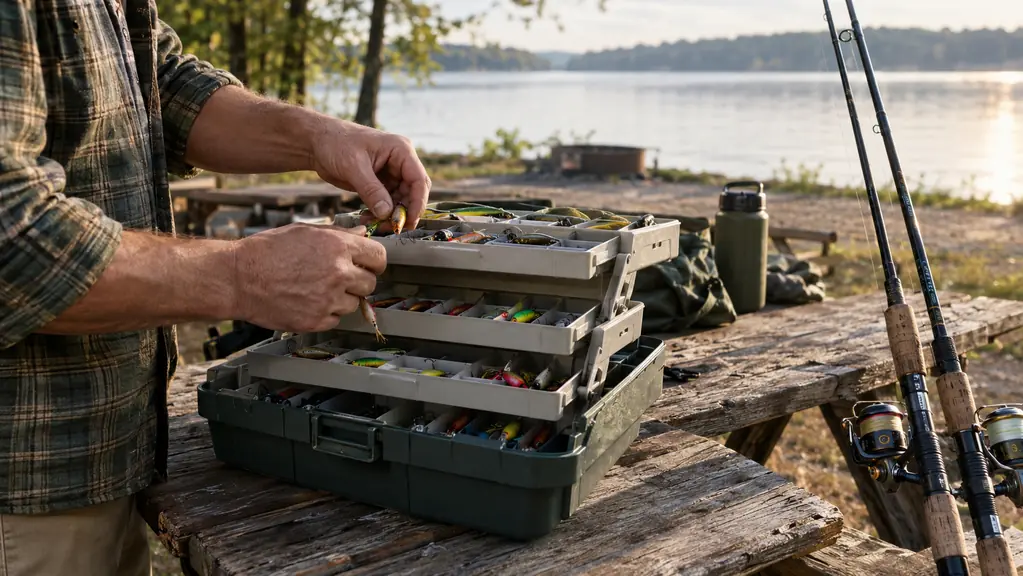
Every spring I tell myself the same thing: this year I will keep the tackle box straight. Then I open it after the first trip and find hooks, weights, and soft plastics all welded into one lump. I am not a neat person by nature. My workbench looks like a disaster. But on the water, a messy box costs me fishing time, and fishing time is the whole point of the trip. For years I carried my lures in a soft tackle bag, and every trip started the same way. I would unzip it on the bank, dig through the tangle, and lose the first twenty minutes of fishing to untangling line while the panfish hit right in front of me. Two years ago I switched to a Plano 3-tray tackle box, and it fixed most of the problem on its own. But a box only helps if you organize it. Here is the system I use, step by step. It takes about an hour once a year, plus five minutes after each trip.
This is not a museum layout. This is a working box that lives in the bed of my half-ton pickup all season and gets bounced down gravel roads on the way to the lake. I am a framing carpenter, so I think about gear the same way I think about my tools: it has to survive the week and be ready when I need it. The system also has to survive a week-long trip in July, when the box rides in the truck for days and gets opened a dozen times a day. It has to let me grab a lure fast when the walleye are hitting at dusk, and it has to make cleanup easy enough that I actually do it. If you fish from shore, from a 12-foot jon boat, or from the bank of a creek, the same steps work. The goal is simple: you should always know where a lure is, and you should be able to get to it without a search.
The box I build this system around: Plano 3-Tray Tackle Box
Three trays, dual top access, and it has bounced around in my truck bed for two seasons without a complaint. If you are replacing a soft bag or starting fresh, this is the box to organize.
Amazon Check Today's Price on Amazon →Step 1: Empty the box and sort everything into piles
Take everything out. Every lure, every hook, every split shot, the line clippers, the little flashlight that fell to the bottom last fall. Lay it all on a table or the tailgate and sort it into piles: hard baits, soft plastics, jigs, hooks, weights, swivels and snaps, tools. Do this inside or in the shade if you can, so small parts do not blow away. I do mine on the kitchen table in March, before the ice is even off the lake, and it has become a small ritual. It also keeps me honest about what I actually own, which is usually less than I think.
This is the step people skip, and it is the step that makes everything else easy. You cannot organize a box you have not looked at in a year. You will find things you forgot you owned, and you will find rusted hooks and cracked lures that belong in the trash, not back in the box. Throw them out now and you save yourself grief in June. I usually end up with a small pile of junk that never should have been in the box in the first place, and the box is lighter for it.
While the box is empty, clean it. Wipe out the trays, blow out the corners, and make sure the latches click shut. A clean box is easier to keep clean, and a box that closes properly keeps dust and rain out. Two minutes here saves a lot of rust later. This is also the time to check the handle and the hinges, because a tackle box that fails on the walk to the boat is a tackle box that fails you for the whole trip.
Step 2: Give each tray a job
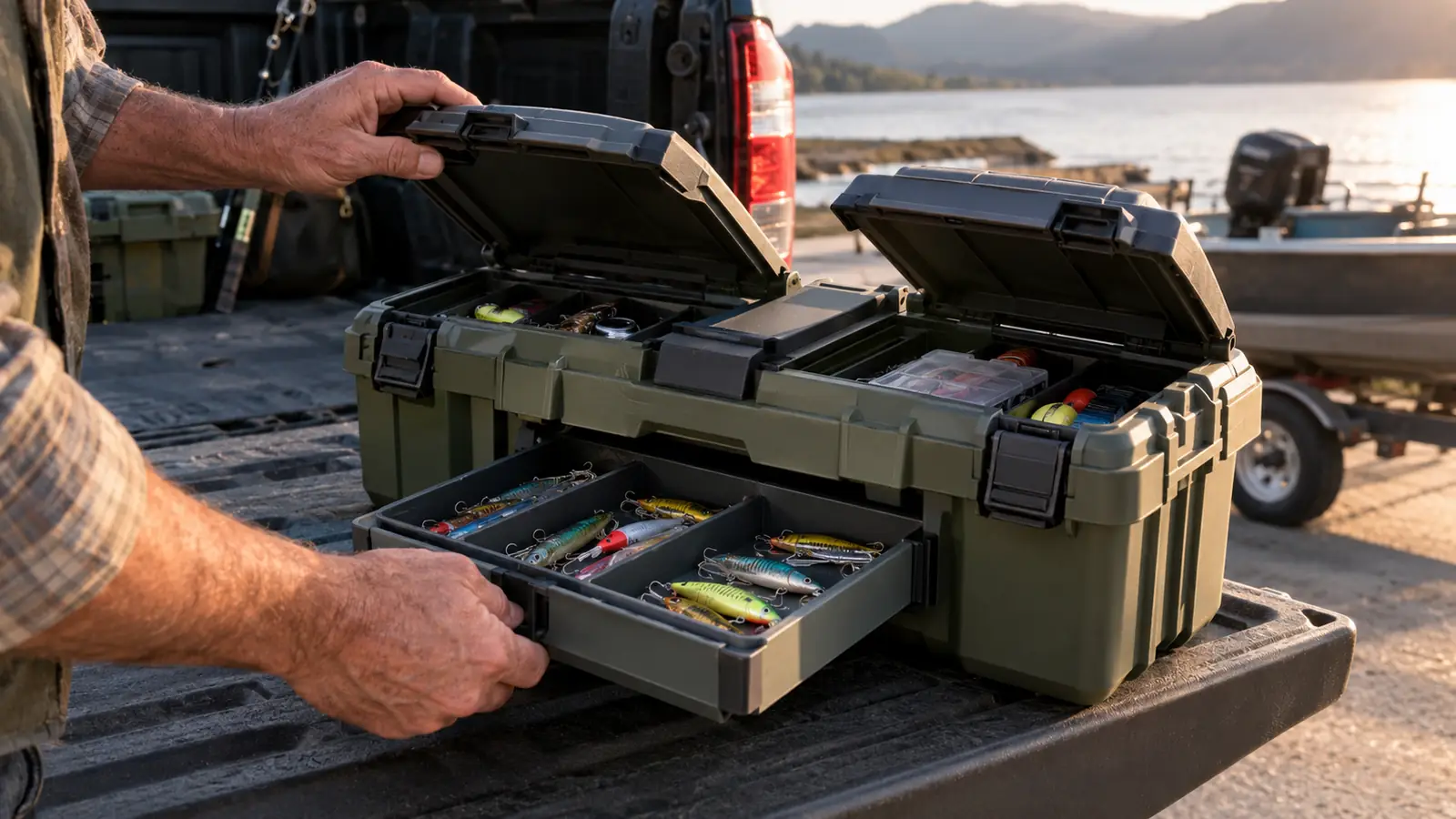
The Plano has three trays, so I divide the work by how often I reach for something. The top tray holds the lures I throw first on any given morning: crankbaits and spinnerbaits. The middle tray holds soft plastics and jigs. The bottom tray holds terminal tackle and tools. Each tray has a job, so I always know where to look. If I am reaching for a spinnerbait, I do not want to dig through a tray of jigs to find it. That sounds simple, but it is the whole point. When I reach for a lure, I do not think about where it is. I know.
The dual top access matters more than I expected. You can open the box from either side, so when one side is a mess from a hard day, you can get into the other side without dumping everything. I bought the box for the trays and the latches, and the dual access turned out to be the feature I use every trip. When the box is sitting on the seat of the jon boat, I can open the side that faces me instead of spinning the whole box around.
If you fish for different species, organize by species instead. One tray for bass, one for panfish, one for walleye. If you fish mostly one species, organize by lure type. The exact labels do not matter. What matters is that you can say where something lives without opening the box. My son Kyle fishes with me a few times a year, and he learned the layout in one trip. That is the test that matters.
Step 3: Stop the tangles before they start
Tangled hooks are the reason most people give up on tackle organization. The fix is simple: never put two treble-hook lures loose in the same compartment. Use the dividers the box gives you, point the hooks the same way, and tuck the hooks into the slots so they cannot grab each other. It is the same reason I keep my framing nails sorted by size on the job: the two seconds it takes to put something away is cheaper than the ten minutes it takes to find it later.
Soft plastics are their own problem. Loose soft plastics melt into one sticky lump by August, and they stain the tray and everything around them. I keep mine in the bags they came in, and the bags sit flat in the middle tray. It is not fancy, but it works, and it means I can see what I own at a glance. When a bag gets down to two or three baits, I restock it before a trip instead of after.
Weights and hooks go in a small parts box, never loose in the tray. Loose split shot rolls under everything and turns the bottom of the tray into a minefield. A small container with dividers, the kind sold for beads or screws, fixes this for good. Put it in the bottom tray and leave it there. I use one with eight compartments, and each compartment has one job: split shot, barrel swivels, snap swivels, hooks in two sizes, and a couple of spare bobbers.
Step 4: Put your go-to lures where your hand lands first
Watch yourself on your next trip. The lures you actually use are probably two or three patterns, not the full spread. Mine are a white spinnerbait, a jointed minnow, and a black and yellow jig. Those three live in the front corner of the top tray, always in the same spot, hooks pointed the same way. When the walleye are hitting at dusk, I can grab the jointed minnow without looking. That is worth more than any other part of this system.
When the fish are biting, you do not want to hunt. You want to reach in, grab, and cast. Keeping the same three lures in the same place every time means you can do it in the dark. On the last trip of the season, I can pack the box for winter in the dark of the truck bed because nothing has moved all year. That matters when the light is going fast and the bite is on.
Everything else gets a home too, but it can live further back. The lures you use twice a season still need a spot. They just do not get the prime real estate. If you add a new lure, the rule is one in, one out. If the box is full, something goes home to the shelf. This keeps the box from growing into a junk drawer over the years, which is what happened to every soft bag I ever owned.
Step 5: Reset the box before it goes back in the truck
This is the step that keeps the whole system working. When the trip is over, take five minutes before you load the truck. Dry off wet lures with a rag, pull weeds and line off the hooks, and put every lure back in its spot. It takes less time than it sounds, and it means the box is ready the next time you open it. The five minutes also gives me a chance to notice what is running low before I am standing in the tackle shop the next weekend. I do this at the tailgate while Terri packs up the camp chairs, and we are usually both done about the same time.
I keep a small rag and a pair of line clippers in the bottom tray just for this. If a hook is bent or rusted, I throw it out right then. Replacing one hook at the tackle shop beats digging through a rusted mess in May, and it keeps the box honest. A box that has junk in it starts to collect more junk. A box that is clean tends to stay clean.
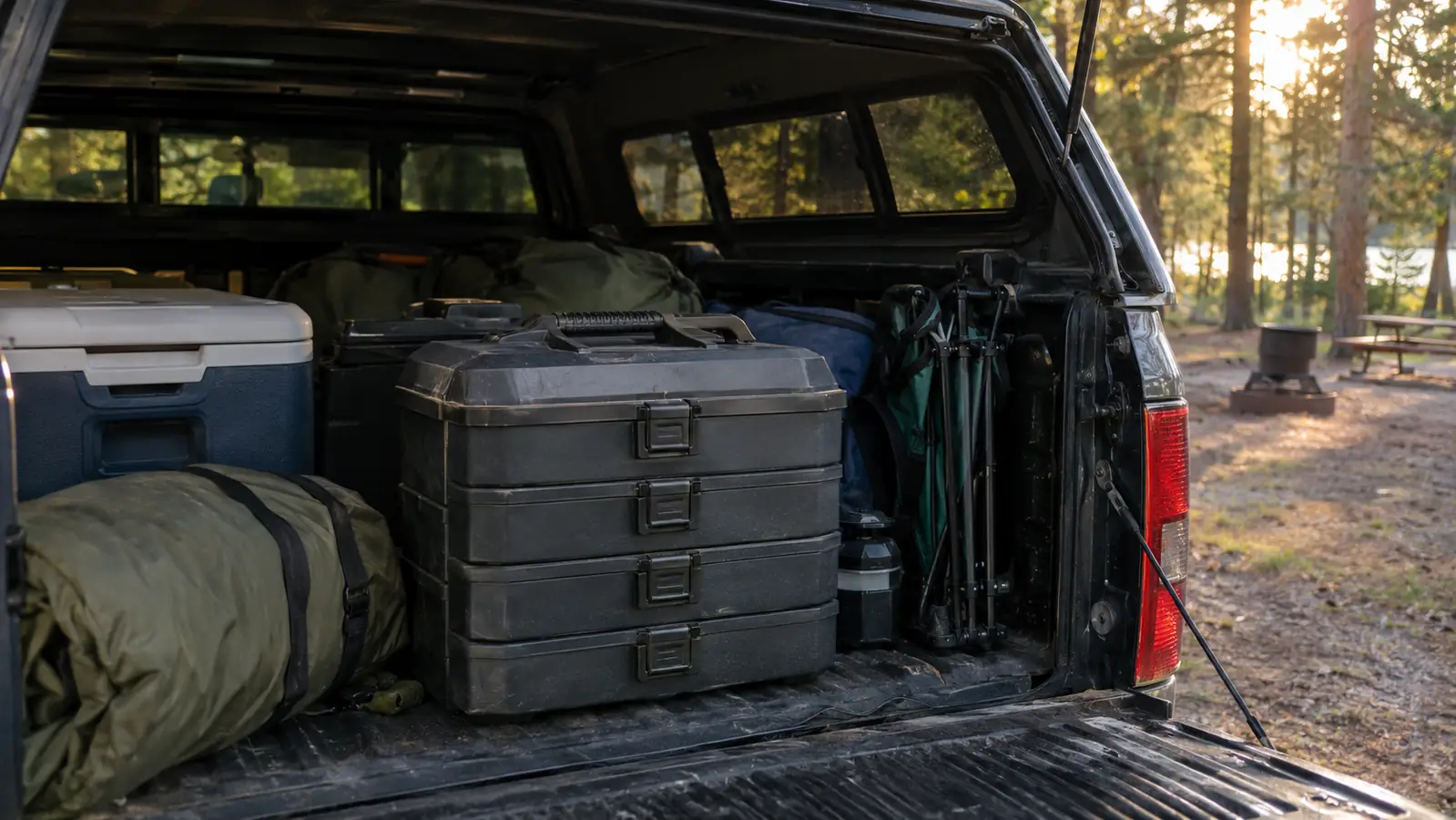
The box lives in the bed cap of my pickup all season, so it gets bounced around and baked in the sun. The reset is what keeps it usable. A box that is organized once and then ignored is a box that ends up a mess by July. Five minutes after each trip is the whole trade, and it is the difference between a system and a hope.
What Else Helps
A couple of small additions make the system easier. A parts box for hooks and weights, a pair of needle-nose pliers for crushed barbs, and a small flashlight that lives in the box and never leaves it. The flashlight matters more than you think. The last cast of the night always ends in the dark, and a light that lives in the box means I can find the pliers instead of guessing. None of it is complicated, and all of it saves time on the water.
If you are starting from scratch, a three-tray box with dual top access is a good place to build from. If you already have a box, the same steps work no matter what it looks like. The system is the point, not the brand. That said, the Plano has held up for two seasons in my truck, and I would buy it again. The latches still click, the trays still slide, and the dual top access still works the way it did the day I bought it.
One more thing: do not overstuff the box. A full box is a messy box. If you carry forty lures and use six, the other thirty-four are just weight. I keep a second small box in the truck for the lures I use on the creek, and only the lake lures live in the three-tray box. Splitting by water type keeps both boxes reasonable.
Five minutes of reset after each trip is what keeps the box from turning back into a tangle by July.
Ready to build your own system?
The Plano 3-tray tackle box is the box I have organized this way for two seasons. Three trays, dual top access, and it takes the abuse of a truck bed without complaint. It is the same box through every step above, and it is worth a look at today's price.
Amazon Check Today's Price on Amazon →