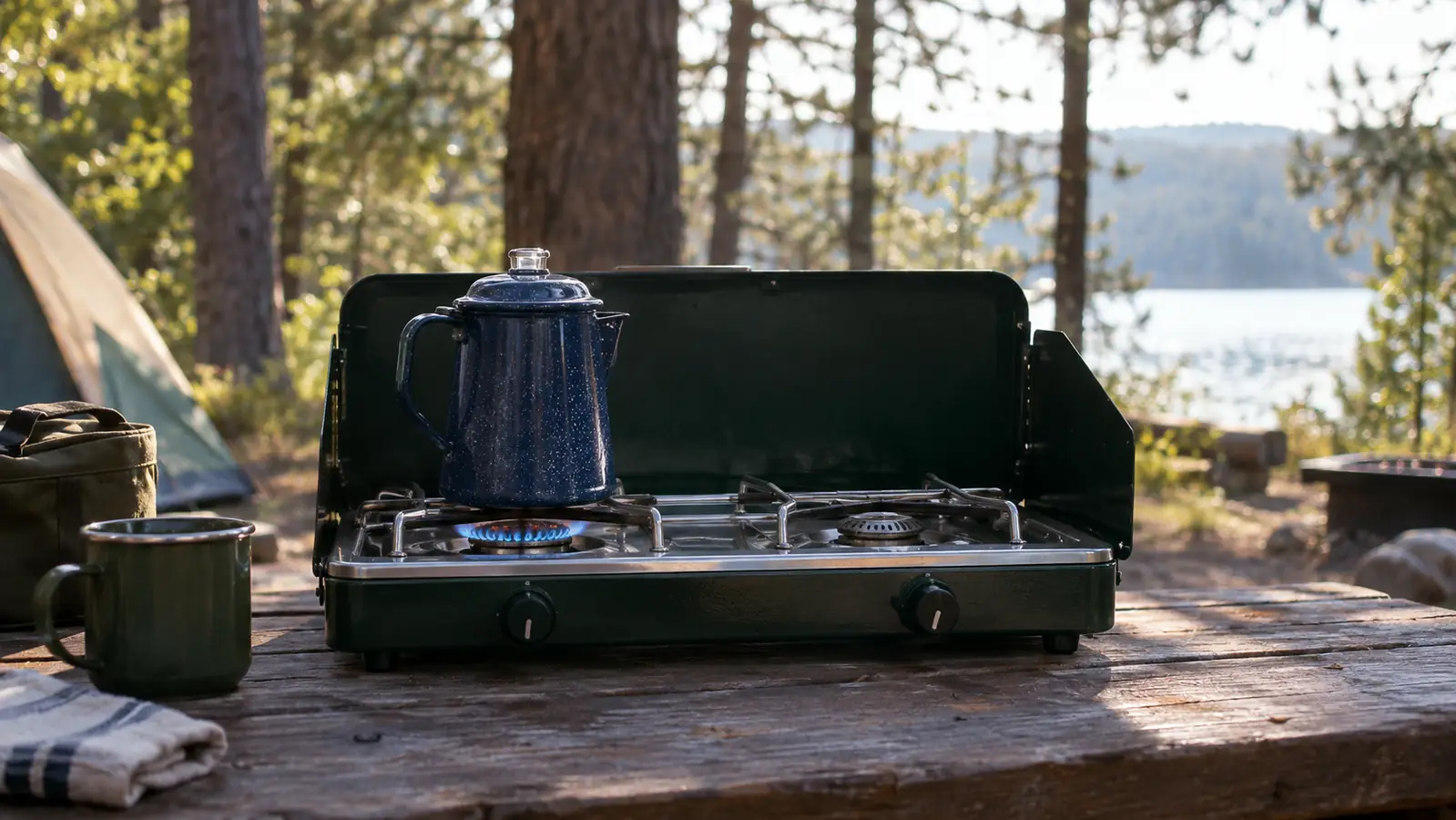
I have used the Coleman Triton 2-burner propane stove on every camping and fishing trip for two full seasons. That is somewhere north of thirty weekend trips and one week-long trip each summer, all in the Finger Lakes region of upstate New York. It has cooked breakfast in the rain, fried fish at the lake, boiled coffee before dawn, and sat in the back of my half-ton pickup for most of the winter. It is not a perfect stove, and I will get the complaints out early. But for a working guy who camps on weekends and needs something that lights fast and keeps cooking, it has earned its place in the truck.
I replaced an old single-burner butane stove with this Coleman two seasons ago, after the igniter on the old one finally quit. I run the Triton on the little 1 lb green propane cylinders, the same ones that fit the lantern, and I keep two spares in the truck bed cap. This review is about what that looks like after months of real use, not after one afternoon in the yard.
The Quick Verdict
The Coleman Triton is the stove I reach for every single trip. It lights fast, boils water quickly, and has taken two seasons of truck-bed abuse without a real failure. The wind screens are thin, the knobs are plastic, and the grates are not non-stick, but none of that has stopped it from cooking a full breakfast for two people in the time it takes to get the coffee going.
Amazon Check Today's Price →The stove that has cooked every trip for two seasons
If you want the same two-burner propane stove I have been running on weekend trips for two seasons, check today's price on Amazon. It is the one I reach for first, and the one I would buy again if this one got stolen out of the truck.
Amazon Check Today's Price on Amazon →How I've Used It
The Triton lives in the truck bed cap all season, which means it gets bounced around, covered in dust, and occasionally used as a table for a tackle box. I have never once treated it gently. It has been rained on, left out overnight by accident, and carried a quarter mile to a lake shore in a tote bag with the cylinders clanking against it. The only care it gets is a wipe-down when I remember.
The first trip with it was a rainy weekend in May at a state park campground near the reservoir. I set it up on the picnic table under the awning and it cooked a full breakfast while the rain came down in sheets. That was the weekend I stopped missing the old stove, and the weekend Terri stopped asking whether we needed to buy a new one. The rain ran off the awning and pooled on the table around the rubber feet, and the stove did not care.
A typical weekend looks like this: Friday night, we pull into the state park campground after dark, and the first thing I do is set the stove on the picnic table and light it for a pot of water. Saturday morning is the real test. Eggs, bacon, home fries, and coffee for two people, all at once, on a table that is not level. Sunday is usually a quick breakfast before we pack up, and then the stove goes back in the truck for the week.
On fishing days, the stove comes down to the lake shore and cooks whatever we caught. Panfish and small bass go in a cast iron pan, and the Triton handles a hot pan without tipping, even on a slope. That matters more to me than any spec sheet number, because a stove that tips when the table rocks is useless.
What the Triton Gets Right
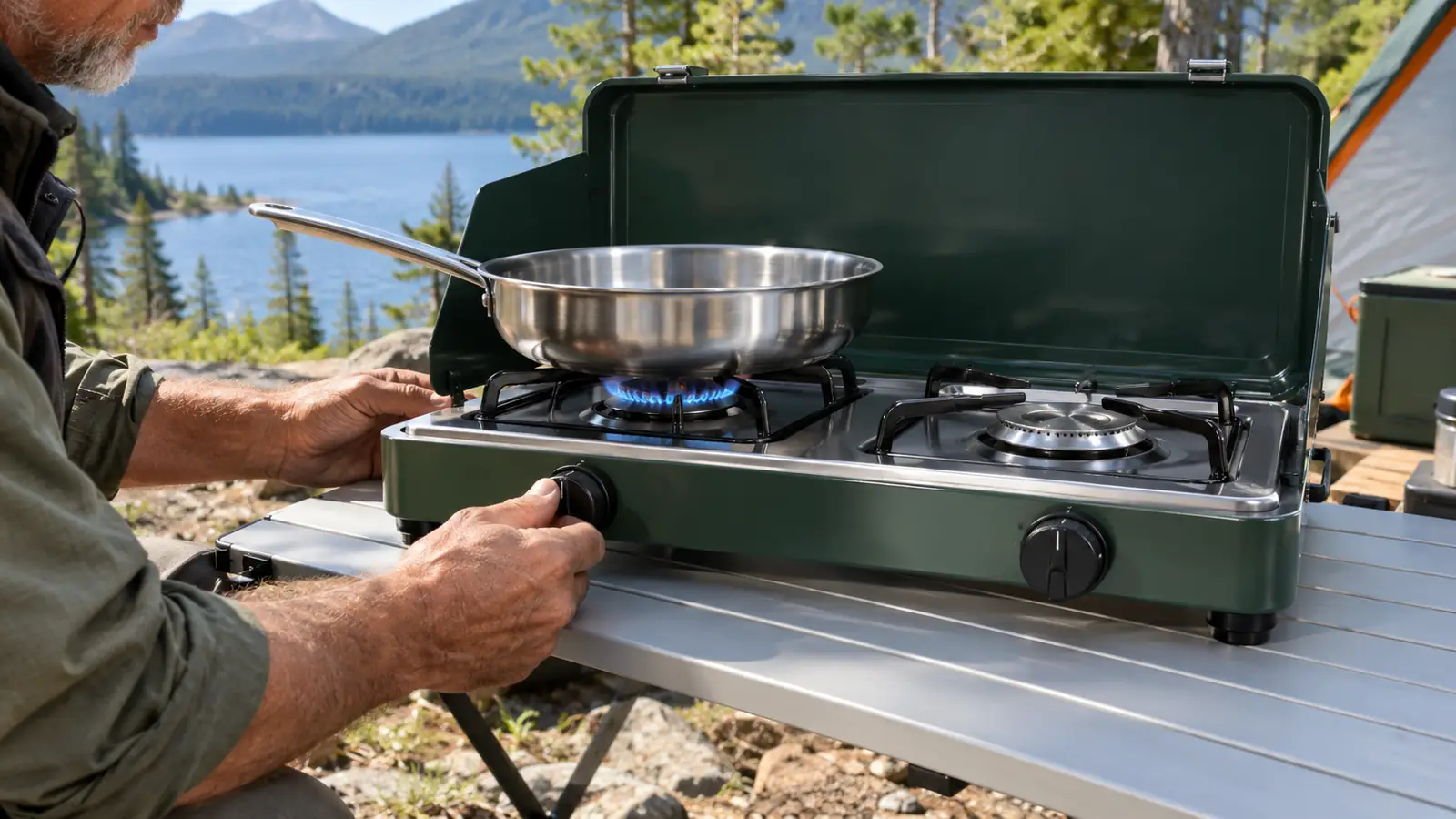
The first thing you notice is how fast it lights. The piezo igniter fires the burner on the first or second click, every time, even after the stove has sat in a cold truck all week. My old butane stove needed a lighter and a lot of patience, and on damp mornings that was a real problem. The Triton has never once needed a match, and that alone was worth the swap.
The second thing is the boil time. A full pot of water for coffee or dishes comes up fast, noticeably faster than the single-burner it replaced. When you are standing outside in the dark at 6 am, that difference is not a luxury, it is the difference between coffee and no coffee. The two burners together put out enough heat that I can run a pan of bacon and a pot of water at the same time without either one dragging.
I timed the boil one Saturday morning: two cups of water for coffee came to a rolling boil in about three and a half minutes on a cool morning, and a full pot for dishes took maybe eight. The old butane stove took twice that, and that was after I got it lit. Numbers like that do not mean much until you are standing in the dark, but they are the reason the coffee is ready before the tent is up.
The third thing is stability. The stove has a wide stance and rubber feet that grip a picnic table, and the lid locks into place as a wind screen when it is open. I have cooked on tables that rocked, on the tailgate, and on a flat rock by the water, and I have never once worried about a full pot going over. For a guy who has seen a cheap stove send a pan of hot grease sliding, that is the feature I actually care about.
Two seasons of weekend trips, and the igniter has never once needed a match. That is the whole review in one line.
Where It Falls Short
The wind screens are the weak point. They are thin metal and they do not block a strong breeze from the side. On a windy lake shore, the flame flickers and the boil time doubles. I have learned to set the stove with its back to the wind or use a folding wind screen I carry for exposed sites. It is not a deal breaker, but it is the first thing I would change.
The worst day was a June afternoon on an open lake shore with a steady breeze off the water. The flame on the back burner dropped to half and the pan of fish took close to twenty minutes to finish. I turned the stove sideways and finished the meal, but that spot taught me to check the wind before I set up. Now I look at the treeline and the water before I pick a spot, the same way I would on a roof.
The knobs are plastic and they work fine, but they do not feel like they will last forever. After two seasons they still turn smoothly and the markings have not worn off, so this is a worry more than a failure. The same goes for the grates. They are not non-stick, and a sticky pan will leave a mark, but they clean up fine with a scrub pad and they have not rusted despite living in a damp truck bed.
The other honest complaint is the cylinders. The 1 lb green propane bottles are convenient and cheap, but they run out at the worst time, usually halfway through the bacon. I have learned to keep a spare within reach and to swap the bottle before it dies completely. A full bottle lasts me about two weekend trips with normal cooking, and a week-long trip takes three bottles. That is not a flaw in the stove, but it is part of the real cost of running it.
How It Cooks, Meal by Meal
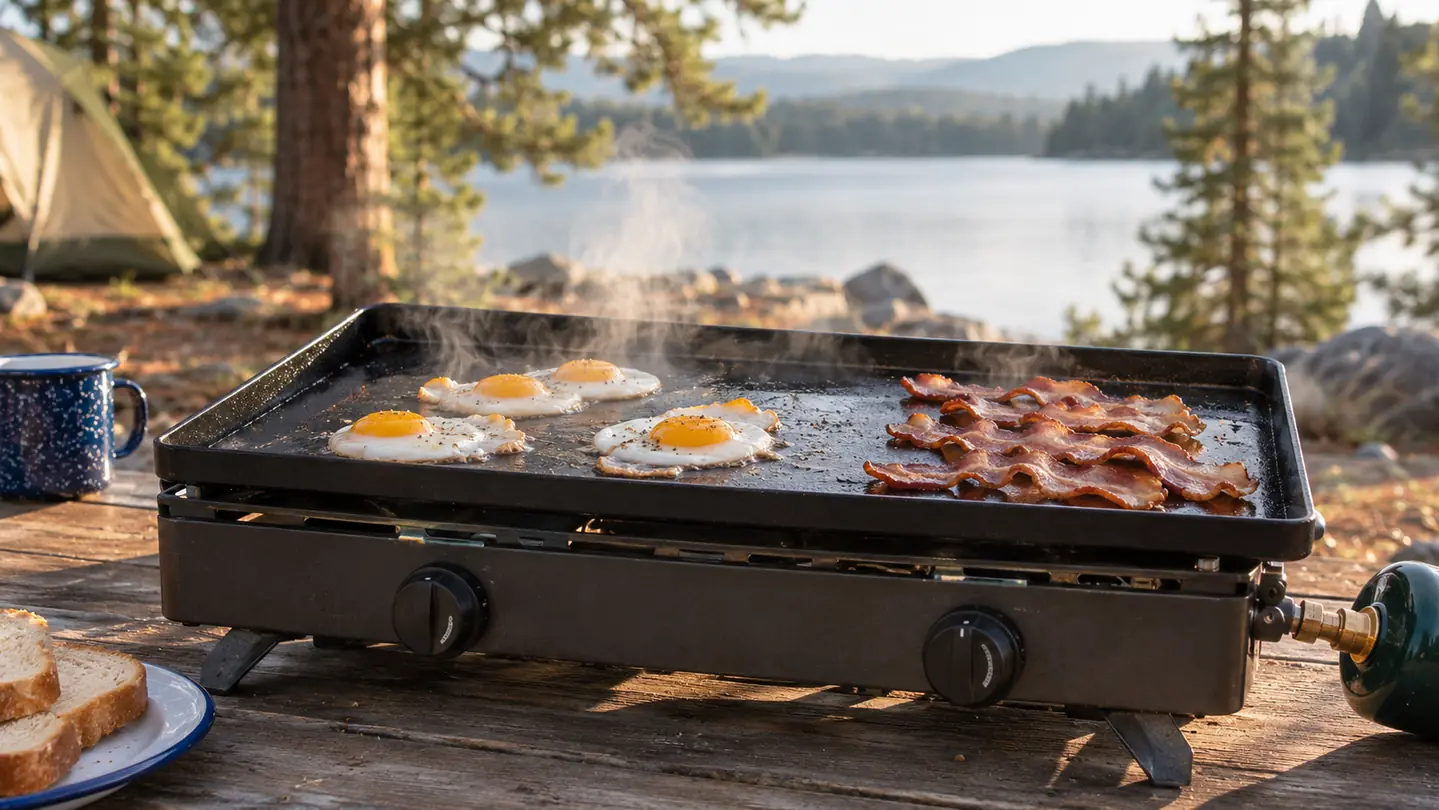
Breakfast is the stove's best job. Two burners means bacon in one pan and eggs in another, or a griddle across both burners for a full camp breakfast. The heat control is good enough that I can simmer a pot of oatmeal without scorching it, which is more than I could say for the old single-burner. The Triton holds a low flame better than I expected from a budget stove, and that matters for anything that needs to cook slowly.
Dinner is where the two burners earn their keep. A pot of pasta and a pan of sauce at the same time, or a pan of fish and a pot of coffee, and the whole meal is ready together instead of in shifts. On the week-long trip, we cooked every night and never once wished for a third burner. Two is the right number for two people.
The meal that sold me was a September trip when I ran a pot of walleye chowder on the back burner and a pan of cornbread on the front. Both finished at the same time, and we ate sitting on a log with the stove still ticking as it cooled. That is the kind of meal a single-burner stove cannot make, and it is the reason I stopped looking at bigger, fancier stoves in the store.
The one meal the Triton does not do well is anything that needs a screaming hot sear. It gets hot, but it is not a high-output camp stove, and a cast iron pan will take a few extra minutes to come up to temperature. For a steak night, I plan ahead. For everything else, it is plenty.
How It Has Held Up
Two seasons is not a lifetime, but it is a real test. The stove has been rained on, bounced around in the truck, and used hard on every trip. The paint has a few scratches, the lid latch still clicks shut, and the rubber feet are still grippy. Nothing has broken, nothing has rusted through, and the igniter has never failed. For a piece of camping gear that cost what this one costs, that is the result I want.
The one thing I watch is the regulator and the hose connection. I check the seal every spring before the first trip by listening for a hiss and smelling for gas, and I replace the cylinder if the connection feels loose. That is basic maintenance, not a complaint. A stove that gets thrown in a truck bed deserves a once-over before it gets lit.
I have also learned to let the stove cool completely before closing the lid. The lid is the wind screen, and closing it hot traps the heat and can warp thin metal over time. I have not seen warping yet, but I treat it like I treat my tools: take care of the small things and the big things take care of themselves.
What I Liked
- Piezo igniter fires on the first or second click, even after the stove has sat in a cold truck all week
- Two burners cook a full breakfast or dinner for two at the same time
- Wide stance and rubber feet keep a hot pan steady on a table that is not level
- Boils water fast enough that coffee is ready before the tent is up
- Survived two seasons of truck-bed abuse with nothing broken and nothing rusted through
Where It Falls Short
- Thin wind screens that let a side breeze double the boil time
- Plastic knobs that work fine but do not feel like they will last forever
- Grates are not non-stick and a sticky pan will leave a mark
- 1 lb cylinders always seem to run out halfway through the bacon
Who This Is For
This stove is for the person who camps on weekends and needs the gear to just work. If you are a tradesman who gets off work Friday, throws the truck together, and wants coffee before you even think about setting up the tent, the Triton is the right tool. It lights fast, cooks for two people easily, and takes the abuse of living in a truck bed.
It is also for the shore angler who cooks the catch. I have used this stove on a gravel lake shore, on a dock, and on the tailgate after a day on the water, and it has never let a hot pan get away from me. If you fish from a small jon boat like I do, the stove stays in the truck and comes out wherever the day ends.
Who Should Skip It
Skip the Triton if you are a hardcore backpacker. It is heavy, it runs on disposable cylinders, and it takes up real space in a pack. For carrying everything on your back, a lightweight single-burner is the right call. This is a car-camp and truck-camp stove, and it does not pretend to be anything else.
Skip it if you need to cook for a big group. Two burners will feed two people with room to spare, and a small family with a little juggling, but if you are feeding six or eight, you will want a bigger cooking surface or a second stove. I know because I have borrowed a second stove for the one week-long trip where my son Kyle joined us with a friend.
And skip it if you want a stove you never have to think about in the wind. The thin wind screens are the one real weakness, and if you camp exclusively on exposed ridges and open lake shores, you will spend your trip repositioning the stove. For the rest of us, a folding wind screen or a sheltered table solves it.
The Bottom Line
The Coleman Triton 2-burner stove is the best value in camping cooking that I have owned, and I have owned a lot of camping gear over the years. It is not the most powerful stove, and it is not the most refined, but it is the one that has never let me down. Two seasons of weekend trips, one week-long trip every summer, and the only thing I have replaced is the propane.
If you are on the fence, think about what a weekend trip actually looks like. You pull in after dark, you are tired, and you want coffee and a hot meal without fighting the gear. The Triton does that, every time, and it does it again the next weekend. That is what I am paying for, and that is what it delivers.
The stove I would buy again tomorrow
After two seasons and more than thirty trips, the Coleman Triton is still the first thing I grab from the truck. Check today's price on Amazon and see if it belongs in your camping kit too.
Amazon Check Today's Price on Amazon →