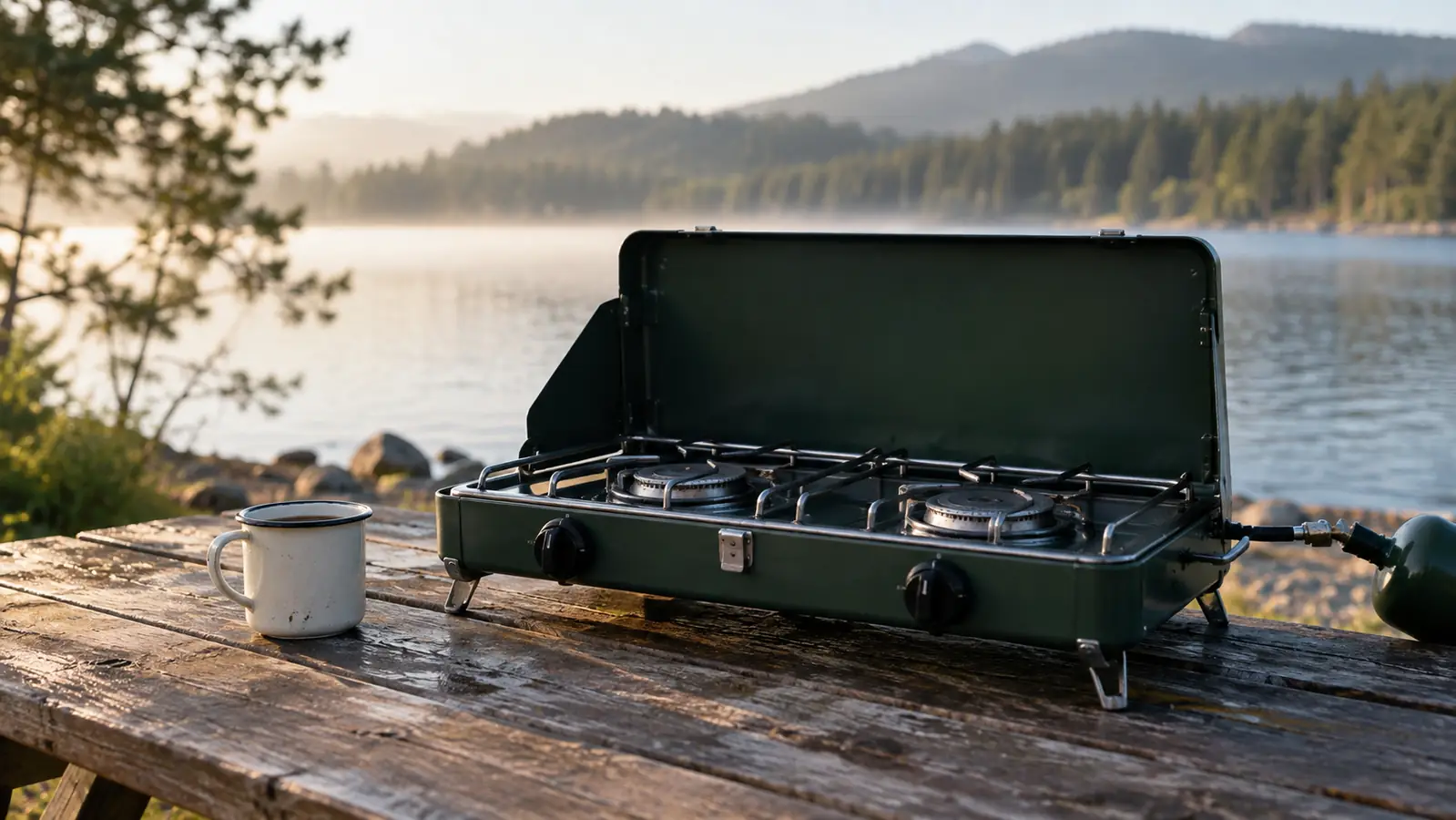
I bought the Coleman Triton two seasons ago, in the spring of last year, to replace a single-burner butane stove whose igniter had finally quit. The old stove owed me nothing. It had cooked a lot of coffee and a lot of canned chili over the years. But it was one burner, it was slow, and the igniter was dead, so I was back to lighting it with a lighter like I was 16 again. I wanted something that would light when I asked it to, hold two things at once, and survive a summer of being thrown in the bed of my half-ton pickup. The Coleman Triton is the stove I landed on. I have used it on every trip since, about two full seasons of weekend camping and fishing in the Finger Lakes, plus the one week-long trip Terri and I take every summer. This is the honest version of that review: what I like, what annoys me, and the campers who should probably skip it.
There are a lot of glowing reviews for this stove online, and most of them are fair. But nobody tells you the parts that get under your skin after the first dozen trips. The wind screens that never quite block the wind. The way the griddle surface cooks eggs fine but hates a cold morning. The knob that feels loose even when it is new. None of that showed up in the first month. It showed up over time, the way all honest product opinions do. So here is the review I wish I had read before I bought it. If you are a working person who camps on weekends, this is for you. If you are looking for a stove to impress your neighbors at the campsite, keep looking.
The Quick Verdict
A solid, dependable two-burner stove that does exactly what Coleman says it does. It lights every time, cooks two things at once, and has survived two seasons of truck-bed abuse. It is not the most powerful stove on the market, the wind screens are more suggestion than shield, and the knobs feel cheap. For most weekend campers it is the right call. For serious cold-weather cooks or anyone who needs real simmer control, look elsewhere.
Amazon Check Today's Price →If you want a stove that lights every time and survives a truck bed, this is the one
Two seasons in, the Coleman Triton has cooked every meal I have thrown at it. It is not perfect, but it is dependable, and dependable is what matters after a long work week.
Amazon Check Today's Price on Amazon →How I've Used It
I am a framing carpenter, which means I spend my work week building things and my weekends trying not to think about building things. Camping is how I do that. Terri and I camp maybe a dozen weekends a year between May and October, plus one week-long trip in July. My son Kyle joins us for a few fishing trips when his schedule allows. We stay at state-park campgrounds and lake shores in the Finger Lakes region, and we fish the creeks and reservoir near home. The stove rides in the bed cap of my pickup, which means it gets bounced, rained on, covered in fishing gear, and occasionally used as a step. That is the test that matters.
We took the Triton on our week-long trip to a state park on one of the bigger Finger Lakes. That trip is the real test, because you are cooking every meal for seven days. The stove did not miss a beat. We cooked breakfast, lunch, and dinner on it every day, and it ran through cylinders predictably. I cleaned it once mid-week, and it looked as good as new. That trip is when I stopped thinking about the stove and started just using it.
I run the Triton on the little 1 lb green propane cylinders. One cylinder lasts us about two full days of normal cooking: coffee in the morning, eggs and bacon, a pan of something for lunch, and fish or burgers at night. I have burned through a lot of those cylinders in two seasons. I have also cooked on it in wind, in light rain, at 6 in the morning when it was 48 degrees, and once in a gusty spot on the lake shore where I had to turn the whole table sideways to keep the flame alive. I know exactly how this stove behaves, and I know exactly where it struggles.
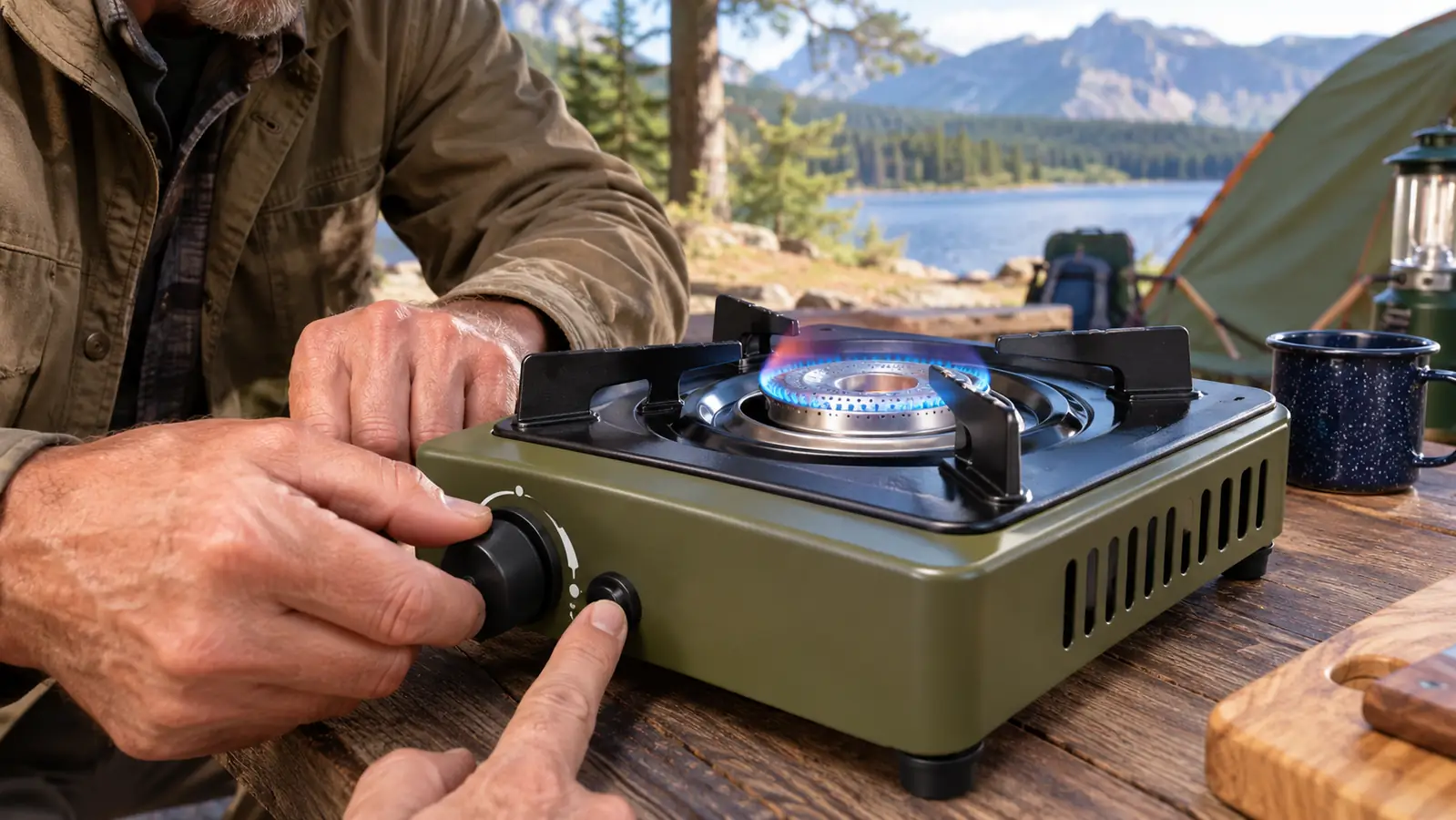
The thing I appreciate most is that it has never once failed to light. The piezo igniter clicks, the burner catches, and I am making coffee. My old butane stove needed a lighter and a prayer. The Triton just works. That sounds like a small thing, but at 6:15 in the morning when you have not had coffee yet, it is the difference between a good trip and a bad one.
What Nobody Tells You About the Triton
The first thing nobody tells you: the wind screens are not really wind screens. They are short metal flaps that fold up on three sides. They help with a light breeze. They do almost nothing in real wind. I have cooked on lake shores where the wind comes off the water all afternoon, and I have had to set up a separate wind break with a cooler and a camp chair to keep the burner lit. If you camp in open, windy spots, budget for that. It is not a dealbreaker, but it is a real limitation.
The second thing: the knobs feel loose. Both of them. They turn fine, they control the flame fine, but they have a little play in them that makes them feel cheaper than the rest of the stove. After two seasons they still work, so it is cosmetic more than functional. But when you pay for a Coleman, you expect the knobs to feel solid. They do not.
The third thing: the griddle surface that comes with the stove is fine, but it is not a true griddle. It is a flat metal insert that sits over one burner. Eggs cook okay. Pancakes cook okay. But it does not distribute heat evenly, and the edges stay cooler than the middle. If you are used to a cast iron griddle at home, this will frustrate you. I mostly cook in a cast iron skillet on the Triton now, and the included griddle stays in the truck bed.
Two seasons in, the Coleman Triton has never once failed to light. That is the whole ballgame for a weekend stove.
The Good, Honestly
Let me give the Triton its due, because it deserves it. The build quality is genuinely good for the price class. The lid is sturdy, the latches work, the legs fold out and lock without fuss. After two seasons of bouncing around in my truck bed, nothing has broken, nothing has bent, and nothing has rusted. I cannot say that about every piece of camping gear I own.
The heat output is respectable. It is not the most powerful stove I have used, but it boils a pot of water for coffee in a reasonable time, and it holds a steady flame for a pan of eggs. The two burners are independent, so I can run one on high for the coffee water and one on low for the bacon. That flexibility is the whole reason to buy a two-burner stove, and the Triton delivers it.
Cleanup is easy. The burner grates lift out, the drip tray slides out, and the whole thing wipes down with a damp rag. After a weekend of cooking fish and bacon, I can have it clean in five minutes. The lid closes over the burners, so it packs flat and stacks nicely in the truck bed. Those are the small things that make a stove worth owning.
Where It Falls Short
The wind screens are the biggest shortcoming. On a calm morning, they are fine. On a breezy lake shore, they are mostly decorative. I have had the flame gutter and flicker in gusts that would not have bothered a stove with taller, more substantial wind protection. If you camp in exposed areas, plan around it.
The simmer control is also not great. The low setting is not that low. I have burned more than one pan of something because the Triton's lowest flame was still too hot for what I was trying to do. For boiling water and cooking eggs, it is fine. For a slow pot of beans or a delicate sauce, you will fight it. This is a stove built for speed and simplicity, not for precision.
And the knobs, as I said, feel loose. They have never failed, but they do not inspire confidence. It is the kind of thing you notice every time you use the stove, even though it never actually causes a problem.
What I Liked
- Lights every time with the piezo igniter, even in cold weather
- Two independent burners handle coffee and bacon at the same time
- Survived two seasons of truck-bed abuse without a scratch
- Easy cleanup with removable grates and a slide-out drip tray
- Packs flat and stacks neatly in the bed cap
Where It Falls Short
- Wind screens are too short to block real wind
- Simmer control is weak, the low setting is still too hot
- Knobs feel loose and cheap
- Included griddle heats unevenly
How It Compares to What I Came From
My old stove was a single-burner butane model that I had owned for years. It was simple and it worked, until the igniter died. The Triton is a different animal. Two burners means I can cook bacon and eggs at the same time, which does not sound like much until you have done it. It also means I can boil water for coffee while the fish is in the pan. That alone is worth the switch.
The butane stove was lighter, and it packed smaller. If I was hiking in, I would take it. But I am not hiking in. I am driving to a state park with a truck bed full of gear, and the Triton's extra size is a fair trade for the extra burner and the reliable ignition. The Triton also feels more solid. The old stove flexed when you pressed on it. The Triton does not.
One thing I did not expect: the Triton uses more fuel than the butane stove did. The 1 lb propane cylinders are convenient, but they do not last as long as a big butane canister. I go through about two cylinders on a long weekend. That is the tradeoff of a two-burner stove, and it is worth knowing before you buy.
Cooking Real Meals on the Triton
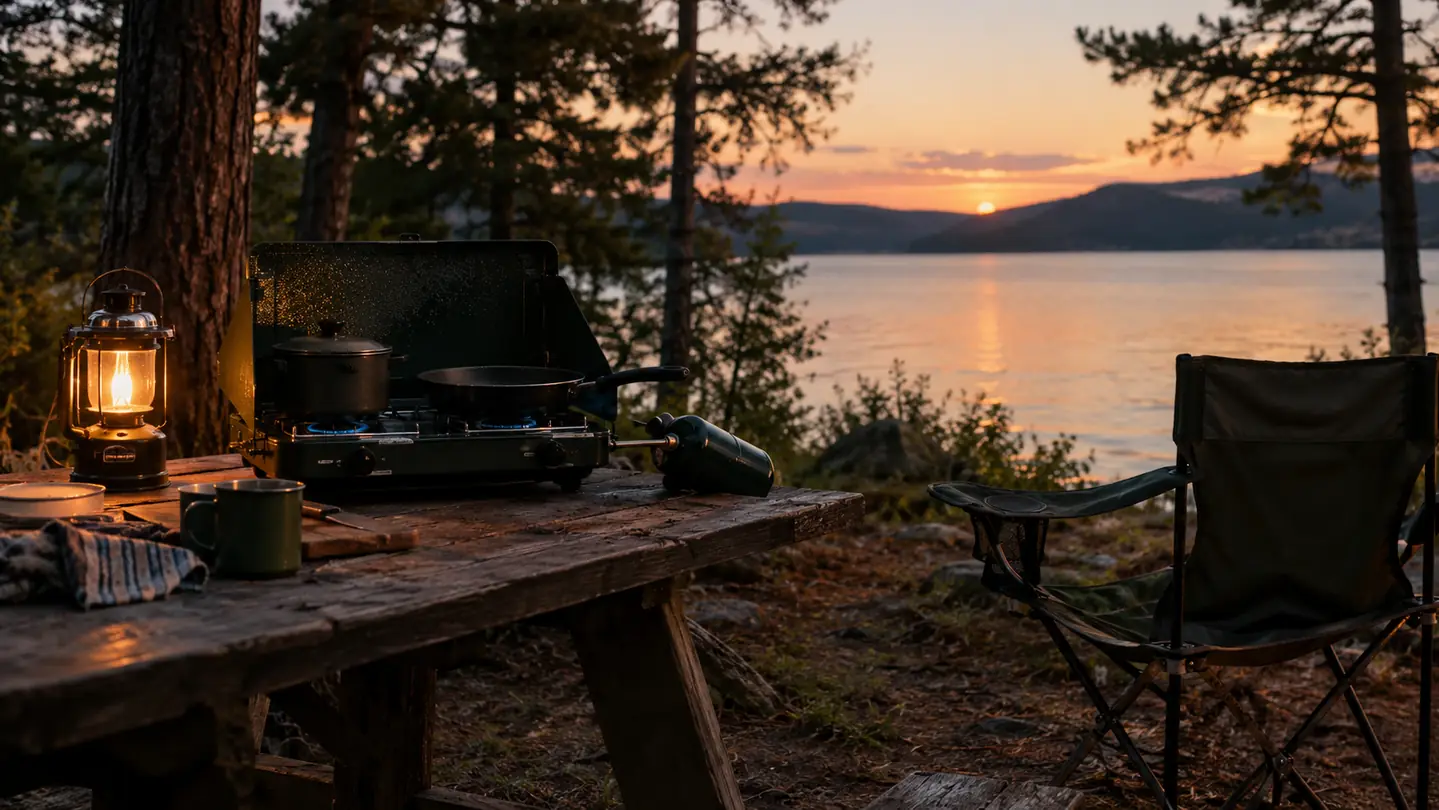
The real test of a camp stove is whether it can cook a full meal without a lot of fuss. The Triton passes. A typical morning for us: I put the coffee water on the left burner on high, and the bacon on the right burner on medium. By the time the water boils, the bacon is half done. I move the coffee pot to the side, drop the eggs in the bacon fat, and we eat. The whole thing takes about 15 minutes, and I am not babysitting the stove the whole time.
Dinner is usually fish or burgers. For fish, I use a cast iron skillet on the left burner and a pot of water for corn on the right. For burgers, I do the same thing with a pan and a pot. The Triton handles both at once without the flame dropping, which is more than I can say for the old single-burner. The only meal that gives me trouble is anything that needs a long, slow simmer. Chili, beans, that kind of thing. The Triton's low setting is not low enough, and I have to stir constantly to keep things from burning.
I have also used the griddle a few times. It makes decent pancakes and decent eggs, but the heat is noticeably uneven. The middle gets hot, the edges stay cool. If you cook a lot of pancakes, you will learn to rotate them. I mostly use a cast iron skillet now, which spreads the heat better and cleans up easier. The griddle is fine for the occasional breakfast, but it is not the selling point the box makes it out to be.
Maintenance and the Little Things
The Triton is low maintenance, which is what I want in camping gear. After each trip, I wipe down the burners and the drip tray, and I make sure the fuel line is clear. I have never had to replace a part. The piezo igniter still fires on the first click, every time. That is the kind of reliability that makes a piece of gear feel like it was worth the money.
One thing I would recommend: keep the stove in the bed cap, not in the cab. It fits fine in the bed cap, and it stays out of the way. Also, check the fuel line connection before you leave. I had one trip where the cylinder was not seated right and the flame was weak. It took me a minute to figure out, and it was my fault, not the stove's. A quick check before you head out saves a frustrating morning.
Who This Is For
The Coleman Triton is for the weekend camper who wants a dependable stove that lights every time, cooks two things at once, and survives being thrown in the back of a truck. It is for the angler who wants hot coffee and a hot pan of fish at the lake shore. It is for the family that camps a dozen weekends a year and does not want to think about their stove. If that is you, this is the stove. It has been the right tool for me for two full seasons, and I do not say that about much of my gear.
Who Should Skip It
If you camp in serious wind on a regular basis, the Triton's short wind screens will frustrate you. If you need real simmer control for slow cooking, this is not the stove for you. If you want a stove that feels like a precision instrument, with solid knobs and a heavy cast griddle, you will be happier spending more money on something else. And if you are a solo hiker who only needs to boil water, a single-burner stove is lighter and cheaper. The Triton is a two-burner stove for people who actually use two burners. That is its job, and it does it well.
The honest bottom line: buy the Triton if you want dependable, skip it if you need precision
Two seasons of weekend trips, one week-long trip, and a lot of fish breakfasts. The Coleman Triton has earned its place in my truck bed. It is not perfect, but it is honest, and honest is what I want from gear.
Amazon Check Today's Price on Amazon →