
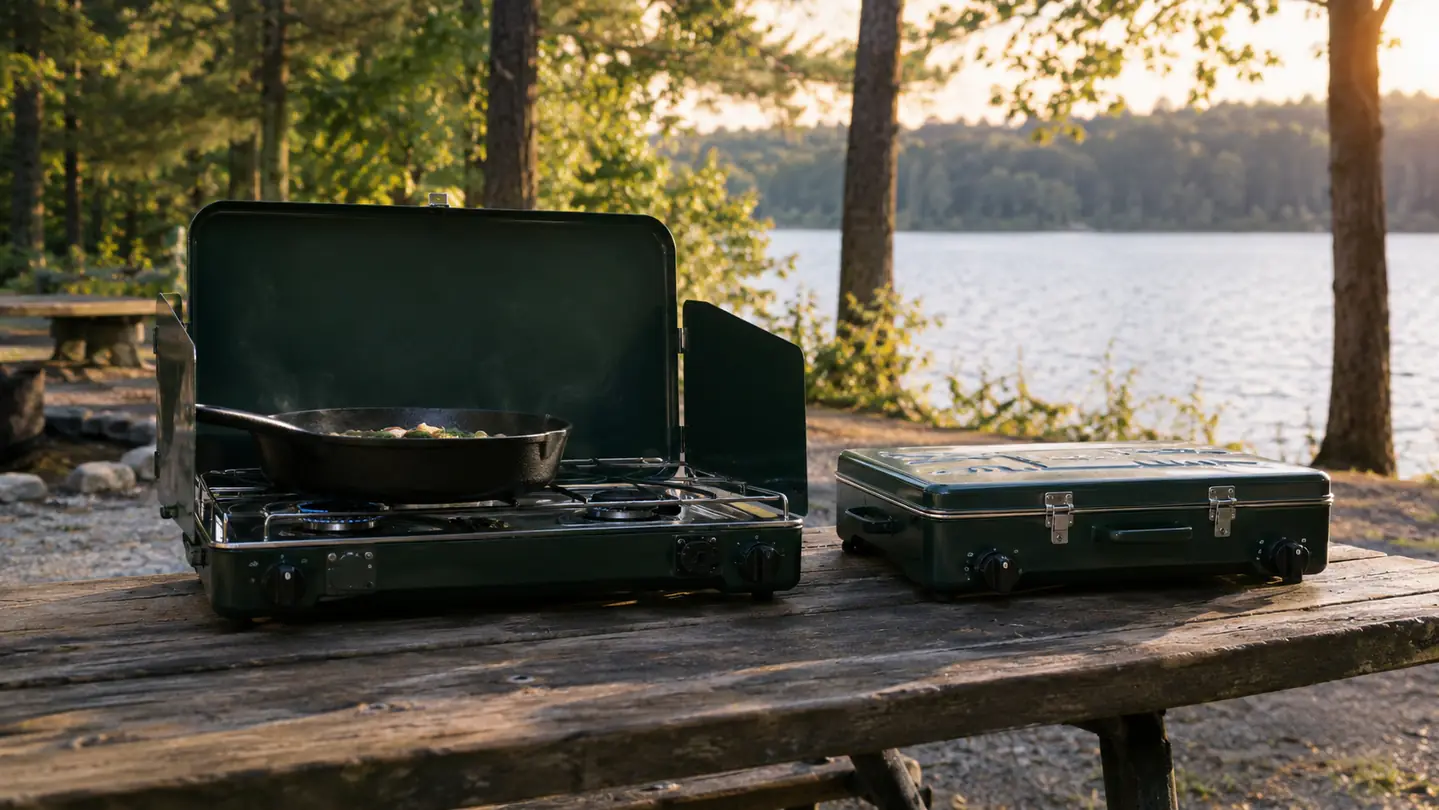
If you camp the way I do, you have one question when you look at a stove: will it still be working in three years, and will it boil water before my coffee gets cold? I have run my Coleman Triton two-burner for two full seasons now, every trip from May through October, and I borrowed a Camp Chef Explorer from a buddy on the crew to run them side by side for a week at the lake. The Coleman came home in the spring of last year, after the old single-burner butane stove quit on the second morning of a trout trip. The igniter had been dying for a while, and I had been working around it with a lighter, but that morning the valve stuck too. I told Terri I was done nursing that thing. She said get one that works. So I did. Here is the short answer before I get into the details.
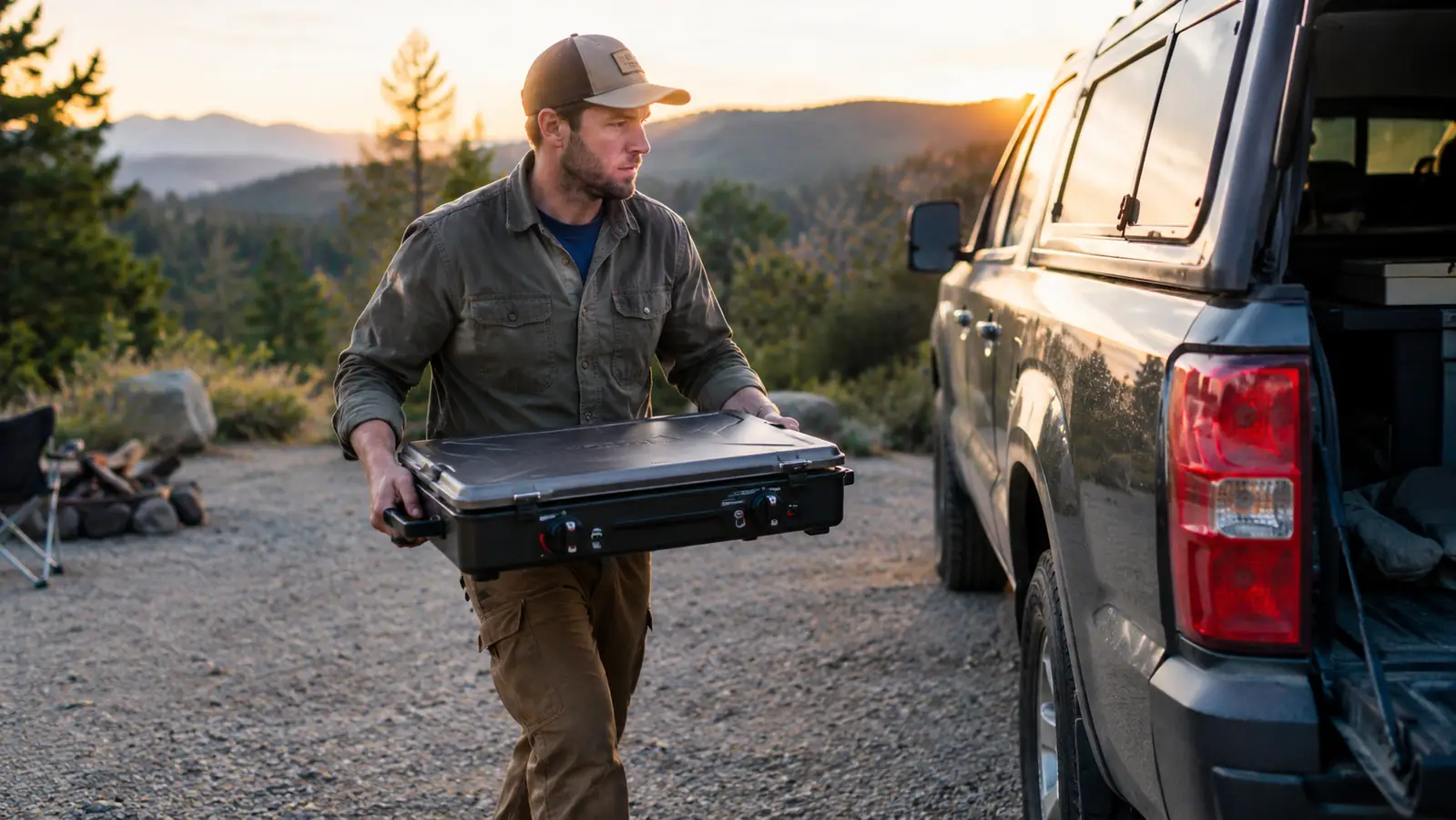
The Coleman Triton is the stove I reach for on a normal weekend. It is lighter, it fits on a picnic table without hanging off the edge, and it has handled everything I have thrown at it. I can carry it one-handed by the side handles from the truck to the table, which matters more after a forty-hour week of framing than it did when I was twenty-five. The Camp Chef Explorer is a bigger machine with a bigger appetite for propane and a bigger footprint to haul. It wins where you need serious output for a crowd. For a working guy who camps weekends and wants gear that survives the truck bed, the Coleman is the one I would buy again.
| Coleman Triton | Camp Chef Explorer | |
|---|---|---|
| Heat output | Two burners, plenty for a 10-inch skillet and a 2-quart pot of water at the same time | Higher total output, boils a big pot noticeably faster, maybe three or four minutes quicker on a cold morning |
| Weight and carry | Lighter, easy to carry one-handed by the side handles from the truck to the table | Heavier and bulkier, needs two hands and more room in the truck |
| Table fit | Sits square on a standard picnic table with room for the salt and pepper | Overhangs a standard picnic table, better on a table or stand built for it |
| Fuel | Runs clean on 1 lb propane cylinders, simple and easy to find anywhere | Same 1 lb cylinders work, but it drinks them faster at full output |
| Windscreen | Built-in windscreen that folds out and does a solid job on a breezy shore | Larger windscreen, better in a real wind, but the stove is bigger to store |
| Durability | Two seasons in the truck bed, no rust, knobs still turn smooth, igniter still fires on the first click | Built like a heavier piece of equipment, but the extra size is part of the price |
| Price | Usually the lower-cost option, and it does the job for most trips | Usually costs more, and you pay for the extra output and size |
| Storage | Slides under the bed cap next to the tackle box all season | Needs a bigger spot, usually the garage between trips |
| Ignition | Piezo igniter has fired on the first click for two seasons | Lights easily too, no real difference I could measure |
| Best for | Weekend campers, anglers, and families who want a dependable stove that packs small | Groups, base camps, and anyone cooking for six or more at once |
Where the Coleman Triton Wins
The first thing I noticed is how the Coleman Triton fits into a normal camping life. My half-ton pickup has a bed cap, and the stove lives under it from the first trip in May to the last one in October. It slides in next to the Plano tackle box, it does not argue about the space, and it comes out ready to work. The Camp Chef Explorer is a fine stove, but it takes up noticeably more room and it is heavier to lift out of the bed after a long week on the job. That matters more than most people admit.
The Coleman also wins on the picnic table. At the state park campgrounds we use in the Finger Lakes, the tables are standard size, and the Coleman Triton sits square on them with the windscreen fully open. The Explorer hangs over the edge, which means I was always checking that the legs were stable and that nothing heavy was sitting on the overhang. For a guy who wants to set up fast after a long work week, the Coleman gets dinner going with less fuss.
The trip that sold me was the second weekend in June. We got to the lake after a wet week of work, and it was spitting rain when we pulled in. I set the Coleman on the picnic table under the awning, clicked the igniter once, and had coffee water going before I had the tent pegs in. The old butane stove would have needed a lighter, a steady hand, and a lot of patience. That morning I watched the flame catch on the first try and I knew I had made the right call.
I have also learned to trust the Coleman in wind. On an October trip the wind came straight off the water and the built-in windscreen kept a 10-inch skillet of eggs cooking without a fuss. I did not have to turn the stove to face the truck or build a windbreak out of coolers. That is the kind of thing you do not appreciate until you have owned a stove that needs it. The Coleman just works, and that is worth a lot at 6:30 in the morning.
The first trip with the Coleman was the opener for bass in May. Terri and I got to the campground late, after dark, and I did not want to fiddle with the old stove. I set the Coleman on the table, clicked it, and had a pan of sausages going in under two minutes. The next morning I made coffee and eggs for both of us and the stove never hesitated. That was the moment I stopped missing the old one.
The only time the Coleman has given me any trouble was a windy morning in September when a gust caught the windscreen and flipped it shut while the pan was on. I folded it back out, turned the flame up a little, and got on with breakfast. That is the whole list of problems in two seasons. I cannot say that about the old butane stove, which needed a new igniter twice and a valve cleaning once before it finally quit.
The stove that has survived two seasons in my truck bed
The Coleman Triton has lit on the first click every trip for two seasons, through wind, rain, and a whole lot of gravel dust. If you want one dependable two-burner that packs small and cooks like it should, this is the one.
Amazon Check Today's Price on Amazon →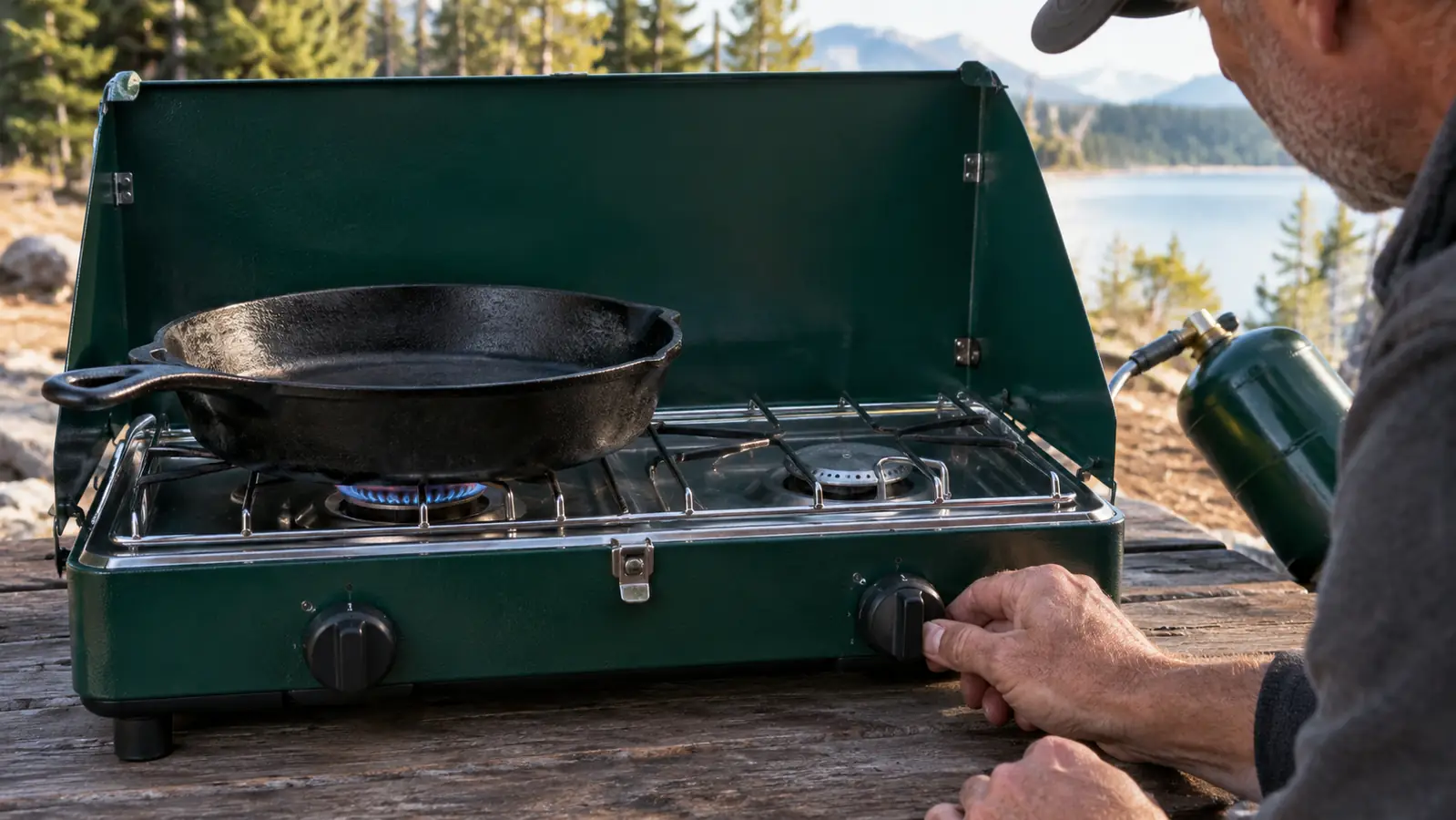
Where the Camp Chef Explorer Wins
I will give the Camp Chef Explorer its due, because it earned it. The week at the lake we had six people eating every night, Kyle and two buddies from his crew plus Terri and me and a neighbor who stopped by. The Explorer handled it like it was built for exactly that. The higher heat output boils a big pot of water for corn or pasta noticeably faster than the Coleman, and when the wind came up off the water, the larger windscreen kept the flame steady. If you cook for a crowd every trip, that extra output is worth the extra size.
The Explorer is also a better fit on a proper camp table or a tailgate that can take its footprint. My buddy runs his on a folding camp table built for big stoves, and it sits there like it belongs. On my normal setup, the Coleman is the better match. But I would not tell anyone the Explorer is a bad stove. It is a bigger stove for a bigger job, and it does that job well. It just is not the stove I want to lift in and out of my truck for a two-night trip.
The night the Explorer really showed off was the Thursday of that week. Kyle brought a mess of walleye he had caught that morning, and I had a 12-inch skillet of potatoes going on one side and a big pot of water for the fish on the other. The Explorer ran both without slowing down, and the water came to a rolling boil in what felt like half the time the Coleman would have needed. I will not pretend otherwise. If I fed a crew like that every weekend, I would own one.
The other thing the Explorer has going for it is stability on uneven ground. The legs are wider and the stance feels planted. On the gravel pad at the lake site it did not rock at all. The Coleman is stable too, but on that same gravel I had to slide a flat rock under one corner. That is not a knock on the Coleman, just a fair note on where the bigger stove earns its keep.
The Explorer also has a wider grate, which matters if you are running a big griddle. My buddy brought his griddle up one morning and it sat across both burners with room to spare. The Coleman grate is a little narrower, and a full-size griddle hangs off the edges. If you cook with a griddle a lot, that is a real difference.
Who Should Buy Which
Buy the Coleman Triton if you are like me: you camp weekends, you fish from shore or a small 12-foot jon boat, and you want a stove that comes out of the truck and works without a second thought. It is the right size for two people, it is easy to carry, and two seasons in, mine still looks and cooks like the day I bought it. For most working families, this is the stove.
Buy the Camp Chef Explorer if you regularly cook for six or more, if you run a base camp for a group, or if you want maximum output and do not mind hauling the size. It is the better tool for that job, and I would say so to anyone. But if your typical trip is two people, a skillet, and a pot of coffee water, the Explorer is more stove than you need, and the Coleman Triton is the smarter pick.
One more thing worth saying. I have owned a lot of camp gear over the years, and I have replaced most of it one piece at a time as things broke. The Coleman is the rare piece I have not had to think about. It sits in the truck bed all season, it comes out when we need it, and it goes back in when we are done. That is the whole job. For the way most families actually camp, that is the stove I recommend.
If you are still deciding, think about the last five trips you actually took. How many people were eating? How much did you cook at once? For me the answer was almost always two, sometimes three, and the Coleman covered it. The one week a year I feed six, I can borrow the Explorer or make do with two skillets. That trade is easy to live with.
I also think about storage. The Coleman lives under the bed cap all season, and I never have to think about where it goes. The Explorer would need a spot in the garage or the back of the truck, and it would be in the way. For a guy who wants gear to disappear until it is needed, that is a big part of the decision.
If you are still on the fence, consider what happens when the stove is not in use. The Coleman takes up almost no space, so it stays ready. The Explorer is the kind of thing you have to plan around. For a guy who grabs gear on a Friday afternoon after work, ready matters. I would rather have a stove that is always there than one I have to dig out of the garage.
My pick for weekend campers and anglers
Two seasons, every trip from May through October, and the Coleman Triton has never let me down. For the way most families actually camp, it is the stove I recommend.
Amazon Check Today's Price on Amazon →