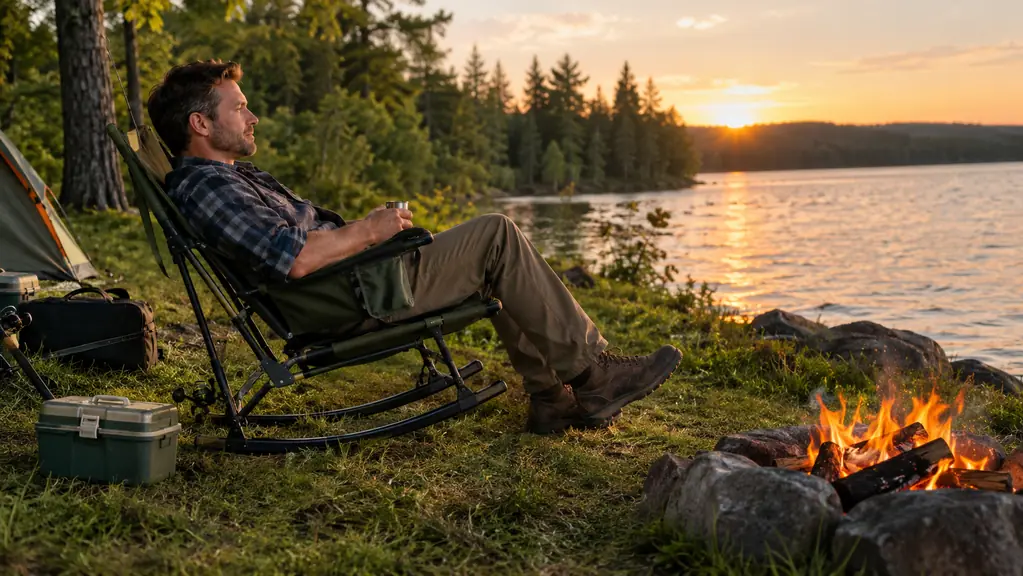
Friday night, 6:40, end of a fifty-hour week. I climb into the truck, drive the hour north to the lake, and the last thing I want to think about is my back. But for years, that's exactly what a camp chair did to me. The cheap bag chairs folded me like a taco. The seats sat so low my knees pointed at the sky. By Sunday morning I was stiff in places I didn't know I had. Last summer my wife Terri bought us a pair of GCI Outdoor Freestyle Rockers after the old chairs tore at the seams, and after a full season of weekends and one week-long trip, I've got some clear opinions about what actually keeps a working back happy at camp.
Here's the thing about a bad camp chair. It doesn't hurt you Friday night when you're tired and glad to be sitting. It hurts you Saturday morning when you try to stand up. And it hurts you Monday morning when you're back on the job site, bending over to set a sill. If you build things for a living, your back is your paycheck. So the chair you sit in for four hours around the fire matters more than most people give it credit for. This is the checklist I'd use if I had to buy a chair again tomorrow, and it's the same list I'd hand my son Kyle before he spends money on his first one.
The chair I reach for after a fifty-hour week
The GCI Outdoor Freestyle Rocker is what I'd put at the top of any camp chair list. It sits high, rocks with you, and has armrests you can actually push off of. Here are the five things to check before you buy any chair, with the Freestyle Rocker as the example.
Amazon Check Today's Price on Amazon →A note on how I tested. I didn't set up a measuring rig or a lab. I used the chairs the way you'd use them, on every trip last season. The Freestyle Rockers went to state park campgrounds, to the lake shore for a week of fishing, and to the creek near home for afternoon outings. If a chair survives what I put it through, it'll survive what you put it through.
Step 1: Check the seat height before you check anything else
The biggest back-killer in a camp chair is a seat that sits too low. When your knees are higher than your hips, your lower back rounds, and a rounded lower back is how you end up with a pulled muscle. Most of the cheap chairs at the big box stores put your backside six or seven inches off the ground. That's fine for kids. It's not fine for a grown man getting out of one after two hours.
When I sit in the Freestyle Rocker, my knees come up to about hip level and my feet stay flat on the ground. That small difference changes everything. Standing up is a straight lift instead of a forward heave. And when you stand up from a chair forty times a day at camp, that adds up fast. My lower back noticed the difference the first weekend. The first weekend we used them, I got up Monday morning and my back felt like it had actually rested. That's the whole point of this exercise.
The test I use now: sit in the chair the way you'd actually sit at camp, then stand up without grabbing anything. If you have to rock forward and throw your weight to get out, the seat is too low. Keep looking. A chair you have to climb out of is a chair that will find your lower back by Sunday.
Step 2: Make sure the backrest reaches your lower back
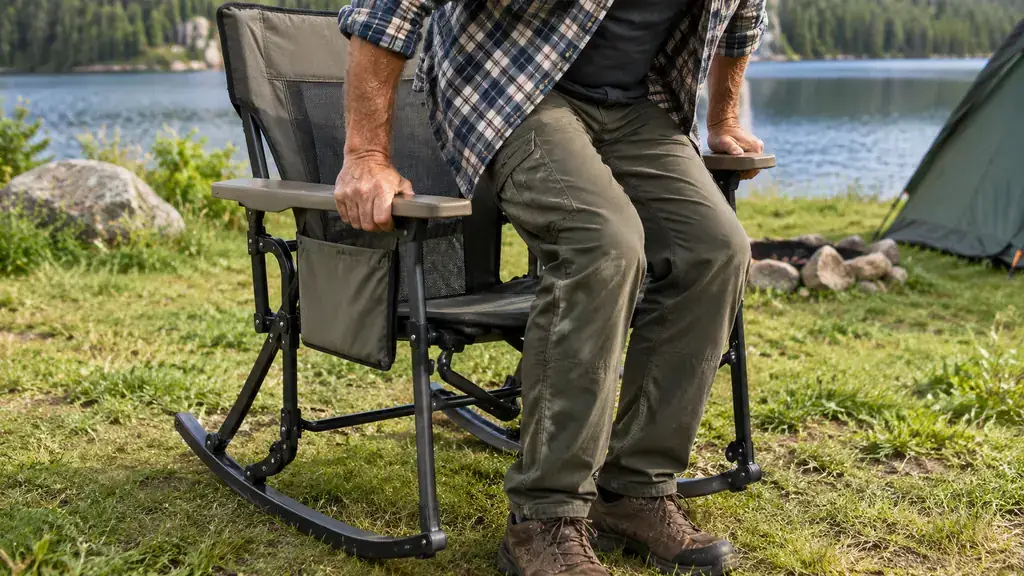
A lot of camp chairs have backs that stop at your shoulder blades or lower. That means your lower back gets nothing. The chair might look comfortable in the store, but you spend the evening holding yourself upright instead of relaxing. The Freestyle Rocker has a backrest that comes up high enough to support the middle of my back, and it has a slight curve that fits the way a person actually sits. The first cheap chair I owned had a back that stopped right at my belt line. I was twenty-five and didn't think about it. Now I check that before I check anything else.
Here's what I look for now. The backrest should be tall enough that you can lean back and feel it against your spine, not just against your shoulder blades. And it should be solid, not a sagging sling. A backrest that sags is the same as no backrest after an hour. You'll know the difference the first time you lean back and the chair actually holds you.
Terri noticed this more than I did. She said the first night in the Freestyle Rocker was the first camp trip she didn't end up with a knot between her shoulder blades. We camp at state parks in the Finger Lakes most weekends from May through October, and that's a lot of evenings spent sitting. A backrest that works matters over a season, not just one night.
Step 3: Get a chair that moves with you
This is the part I was skeptical about. A rocking camp chair sounded like a gimmick, something you'd see in a catalog and laugh at. Then Terri came home with two of them, I sat down, and the first time I leaned back and the chair rocked with me, I got it. The motion lets you shift your weight without getting up. Your back gets to change position, which is exactly what it's asking for when it starts to ache.
The GCI Outdoor Freestyle Rocker rocks on a curved base, and the motion is smooth, not tippy. You can rock gently or sit still. The rock is what keeps your lower back from locking up over a long evening. I've sat in mine for four hours of fishing talk at the lake and gotten up without the usual stiffness. That never happened in a straight-legged chair. I fish from a twelve-foot aluminum jon boat on the reservoir, and after a day of standing and casting, sitting in a chair that rocks is the closest thing to a stretch I get before dinner.
If you're shopping, don't take my word for it. Sit in the chair and rock. If the motion feels jerky, or the chair feels like it's going to tip, walk away. The rock should be the most forgettable part of the chair, the thing you stop noticing after ten minutes. When it works, you don't think about it. You just sit easier.
Step 4: Look for armrests you can push off of
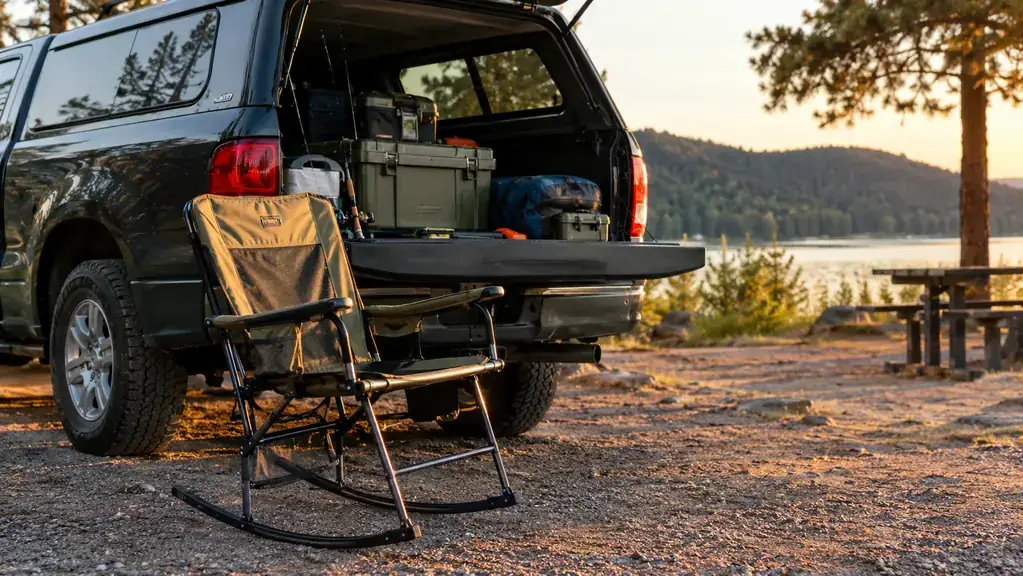
Getting out of a camp chair is where most back trouble actually starts. You're tired, the ground is uneven, and you heave yourself up with your arms. If the armrests are skinny plastic tubes, your hand slips and your back takes the load. The Freestyle Rocker has wide, solid armrests I can actually push down on. They don't flex, and the chair doesn't tip when I use them to stand up.
That last part matters more than it sounds. A lot of chairs with cup holders put the armrests at an angle or make them too narrow to grip. I'm not a small guy, and I need an armrest I can trust at eleven o'clock at night when I'm getting up to check the fire. A chair that tips when you push off it is a chair that's going to put you on the ground.
The armrests also have a flat spot wide enough for a coffee cup. That's a small thing until you've spent a morning trying to keep a mug balanced on a round tube. The drink holder on the right armrest is a bonus, but the flat, solid armrest is the part I'd insist on in any chair I bought. I've watched people grab the front bar of a cheap chair to stand up and nearly take the whole thing with them. You want the armrest to be the thing you grab.
Step 5: Buy the one that survives the truck bed
Every chair looks good in the store. The question is what it looks like in October after a season of being thrown in the back of a half-ton pickup, strapped down over firewood, and set up on gravel. The bag chairs we had before tore at the seams within a season. The Freestyle Rocker has a steel frame and a woven seat that has held up through a full season of weekends and one week-long trip. No loose screws, no torn seams, no sag. The steel frame has a few scuffs from the firewood, and that's fine. Scuffs mean it's being used.
It folds flat and carries over the shoulder like any camp chair, and it stands on its own when you set it down. That doesn't sound like much until you're carrying a chair, a tackle box, and a rod down to the lake in one trip. Mine rides in the truck bed with the rest of the gear all season, and it takes the abuse without complaint.
One honest note. The woven fabric will fade if you leave it in the sun all season, and the rocking base picks up sand if you set it up on the beach. Neither has caused me a problem, but I also don't leave my chairs out in the weather. Treat it like gear instead of furniture and it'll treat your back right.
What Else Helps
Even the right chair won't fix a back that's already angry. A few habits help as much as the chair itself. I keep my feet flat on the ground instead of tucking them under the seat. I get up and walk the camp once an hour, even if it's just a slow lap around the fire. And when I'm reading in the chair, I put a small folding footrest under my legs. That takes the pull off my lower back. The chair does the heavy lifting. These habits keep it from having to.
The other thing I'd tell you is to buy two. If you're shopping for a chair for yourself, get one for the person you camp with too. Terri and I both use ours every trip, and the pair has held up better than the four cheap chairs we went through before them. A chair you actually use beats a chair you save for company. We also keep one in the bed of the truck for the days we fish the reservoir after work, and it's the chair we argue over.
One more thing. If you're shopping online, read the reviews for the word 'wobble' and the word 'sag.' Those two words will tell you more than any marketing photo. A chair that wobbles on flat ground is a chair that will wobble on gravel, and a chair that sags in the seat is a chair that will put your lower back in a bad position by the end of the night.
A full season of weekends and one week-long trip, and the Freestyle Rocker still has no torn seams and no sag in the seat. The chairs before it didn't make it to July.
Here's where I land. You don't need the most expensive chair in the catalog, and you don't need the lightest one either. You need a chair that sits at the right height, supports your lower back, moves when you move, gives you an armrest you can trust, and survives a season in a truck bed. The GCI Outdoor Freestyle Rocker is the first chair I've owned that checks all five boxes. My back agrees, and after a fifty-hour week, my back is the one that votes. If you're on the fence, start with one chair and use it for a season. That's the only test that counts.
The chair I'd buy again tomorrow
After a full season, the GCI Outdoor Freestyle Rocker is the camp chair I'd pick again. It sits high, rocks with you, and takes the abuse of a truck bed. If you're tired of chairs that leave you stiff on Monday, this is the one to start with.
Amazon Check Today's Price on Amazon →